I have lost more time this year trying to be fair to people than I have lost to almost anything else.
That is an ugly sentence, which is unfortunate, because it is also true.
I don’t mean fair in the clean, reasonable, policy-document sense. I mean fair in the way a guilt-haunted founder means it.
Fair as in: maybe the brief was unclear.
Fair as in: maybe I moved too fast.
Fair as in: maybe she just needs one more round.
Fair as in: she’s kind, and she’s trying, and she has been hanging around for months hoping I’ll give her a way in, and what kind of person builds the door and then closes it?
Me, apparently.
Eventually, me.
I built a paid test because I wanted a clean answer. That was the whole point. I needed to know whether someone who had been pitching herself into my orbit could actually take work off my plate.
That sounds sterile when I write it that way. “Take work off my plate.” Like this was a cute little delegation exercise and not me trying to grow a publication without becoming the emotional infrastructure for every person who wants to be near it.
The assignment was small. Ten keywords. Research judgment. Search intent. Reader fit. The kind of work that looks simple until you care about whether the output is useful, safe, aligned, and not secretly a liability cosplaying as a spreadsheet.
It did not go well.
Worse than that, it did not go well in the specific way that activates every broken little founder circuit I own. She was sweet. She was receptive. She thanked me for the feedback. She tried to revise. She said she had learned something, even in the smallest way.
And God help me, that phrase got in.
Kindness is not the same as capacity
Because I edit Many Words One Voice. Because I care about people who are trying. Because I know what it feels like to be rough around the edges and still worth someone’s patience. Because I have built entire pieces of my life around the belief that people are more than their first failed attempt.
All true.
Still not the job.
That is the part I keep having to learn with a level of drama I frankly resent.
Kindness is not capacity.
Effort is not readiness.
Potential is not a deliverable.
And my ability to understand why someone is struggling does not magically create room in my business for the cost of their struggle.
The guilt gremlin does not arrive as a villain
The founder guilt gremlin hates this. Obviously.
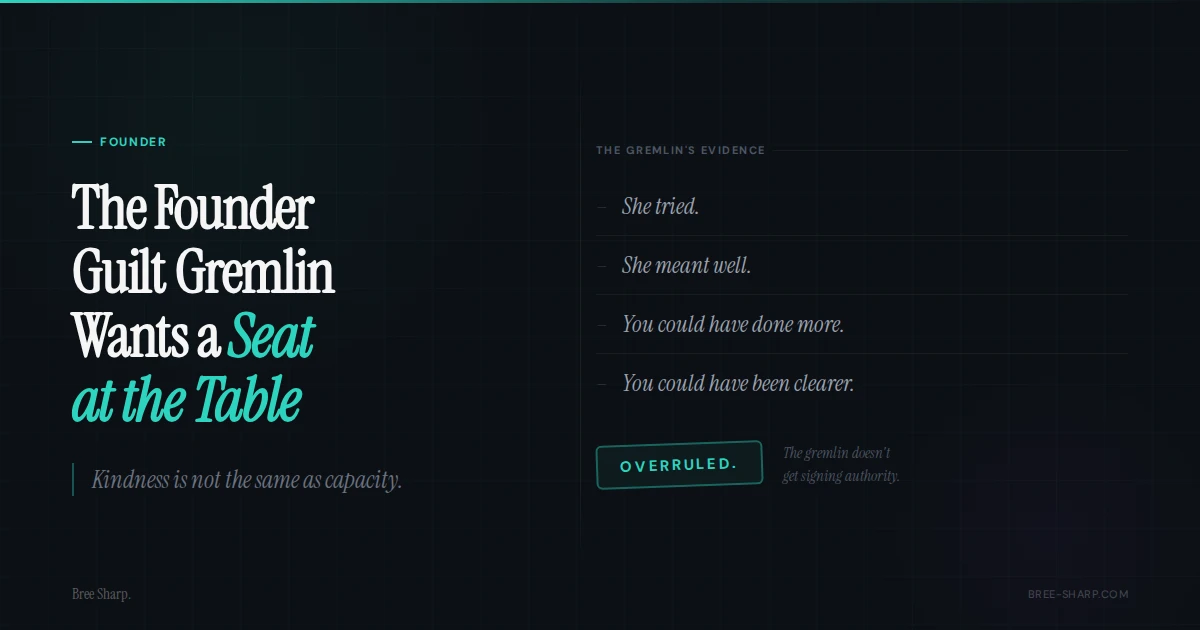
The founder guilt gremlin does not arrive as a villain. That would be too easy. It arrives as a committee. It sits down at the table with a little notepad and starts presenting evidence.
She tried.
She meant well.
She was nervous.
You could have been clearer.
You could have been more patient.
You could have given one more round.
The gremlin is annoying because it does not lie. That’s the real problem. It does not have to invent evidence. It just presents partial truth with the confidence of a tiny, unlicensed attorney.
She did try.
She did mean well.
I probably could have been clearer somewhere. I can always find a place to accuse myself of insufficient clarity if I dig long enough. That has been one of my more expensive hobbies.
But there is no natural endpoint to “more patient” when the person funding the patience is also the person bleeding from it.
This was the shortest cycle yet in a much longer pattern
And I need to be painfully honest about that part, because this was not one failed contractor test in a neutral room.
This was the shortest cycle yet in a much longer pattern.
I have spent thousands of dollars this year on “maybe it was me.”
Maybe I was unclear. Maybe I moved too fast. Maybe the expectations lived too much in my head. Maybe if I gave better notes, better examples, better structure, better patience, the work would become what I needed it to be.
Sometimes that is true. Sometimes founders are unclear. Sometimes the system is the problem.
And sometimes the work is just not good enough.
I hate that sentence. I hate how cruel it feels in my mouth, even when it is accurate. I hate it more when the person is kind, or young, or earnest, or clearly trying.
But my discomfort with accuracy has become expensive.
I have paid for “absolutely, it’s done — can you queue up more work?” when it was not, in fact, done.
I have paid for work I am nearly certain was outsourced without discussion, consultation, or quality control, which made it awful in two directions at once: bad from the source and bad in the handoff.
I have paid for the particular circus act of finding GPT parameters in a draft, being handed an access-issue excuse, and then checking the WordPress logs because, unfortunately for everyone involved, I had already been lied to once and had installed the plugin to prove it next time.
I have paid for the part where holding a standard somehow became evidence that I “might not be mentally well.”
No, really.
I have paid for the part where I had to explain the assignment again. And again. And again. I have paid for the part where “trying” became a reason I felt obligated to keep reviewing work that was not usable. I have paid for the part where my empathy kept translating poor fit into “maybe they just need one more chance.”
So no, I do not think I could give more.
Not really.
I had already been giving from the business equivalent of overdraft protection.
There is no fake money here
And I am not a VC-funded startup. I am not operating from a baseline of massive success where bad hires, failed tests, unusable drafts, and broken trust disappear into some investor-backed burn rate.
I am one person funding this startup as one of several.
I am funding it with my personal income. I am funding it with forty-hour weeks of my own labor on top of the full-time hours I already spend on my other businesses. I am funding it from the same checking account my income taxes come out of, the same account my bills come out of, the same account that has to keep my actual life standing upright while I try to build something that does not yet know how to hold its own weight.
There is no fake money here. There is no abstract founder-cost bucket where all of this gets absorbed by the universe and turned into a lesson.
Every risk I have taken came out of my real life. Every risk I continue to take does too.
And I have been eating that cost even when the work was not genuine, was not what I agreed to, was not usable, and was not reducing the load it was supposed to reduce.
That is not sustainable.
It is also not noble.
It is just expensive.
What it costs when empathy runs operations
And this is where the guilt gremlin gets loudest, because it knows I am susceptible to any argument that sounds like care.
I run a mental health publication. I think about emotional labor, overextension, survival patterns, burnout, and the cost of being the person everyone else processes through. I know this material. I have edited it, shaped it, published around it, lived too much of it, and recognized it in other people with the kind of clarity that makes me feel competent right up until I do the exact same thing in a new outfit.
That is the humiliating part.
I know what it costs to be the processing center.
I still built one into my business.
I called it patience.
I called it leadership.
I called it being fair.
Some of it probably was. I am not interested in becoming the kind of founder who mistakes coldness for strength. I do not want to build something sharp enough to cut everyone who reaches for it.
But there is a difference between giving someone a fair chance and giving them access to your operating system.
There is a difference between mentoring someone and accidentally funding their learning curve because you were too guilty to admit they were not ready for the work.
There is a difference between seeing someone clearly and becoming responsible for what they are not yet able to do.
That difference has cost me money.
It has cost me time.
It has cost me momentum.
More dangerously, it has cost me trust in my own standards.
That might be the worst part. Not the invoices. Not the bad drafts. Not even the surreal experience of needing WordPress login logs to prove reality to myself in my own publication.
The worst part is what repeated boundary erosion does to your inner floor.
You start with a standard.
Then someone misses it.
Then they are kind about missing it.
Then you feel guilty.
Then you explain.
Then they miss it again.
Then you explain better.
Then the work still is not usable.
Then the guilt says: are you sure this is not your fault?
By the time you finally say no, you are no longer just making a business decision. You are crawling out of a small psychological sinkhole with a clipboard in your hand, trying to act normal.
This is what it costs when empathy runs operations instead of informing them.
Not just money, not just time. It costs you your relationship with growth itself.
The lesson cannot be “never hire again”
I want Many Words One Voice to grow. Painfully. I want more voices, more range, more reach, more capacity. I want the thing to be bigger than my own nervous system.
Especially that.
But my lived experience of growth this year has not been “more support.”
It has been more people to manage, correct, soften, redirect, reassure, pay, review, emotionally interpret, and eventually release with enough gentleness that I could still recognize myself afterward.
That is not a hiring funnel.
That is a haunted house with invoices.
And the brutal little joke is that avoiding growth has its own cost. Staying small does not protect the mission. It just keeps the mission trapped inside what I can personally carry. That might feel safer in the short term, but it is not actually safety. It is containment.
So the lesson cannot be “never hire again.”
That is fear wearing a blazer.
The lesson is that my business cannot keep depending on my empathy as infrastructure.
My empathy can inform the standard. It cannot replace it. It cannot become the loophole through which every bad fit gets another round, another explanation, another payment, another week of my life.
This is the part I wish were softer.
It is not.
I can care about your potential and still know it is not my job to build it.
I can believe you are trying and still know the work is not usable.
I can be sorry that the answer is no and still let it be no.
I can be a person with an overly functional empathy mechanism without being in the business of being one.
That is the line I am trying to hold now.
Not perfectly. Obviously. If I were perfect at this, I would not be writing a whole essay because a spreadsheet hurt my feelings.
But cleaner than before. Shorter than before. With fewer expensive little detours through “maybe it was me.”
The guilt gremlin still wants a seat at the table. It can have one, I guess. I am not unreasonable. It can sit there with its tiny notepad and make its objections.
She tried.
She meant well.
You could have done more.
Fine.
Entered into the record.
Overruled.
The gremlin does not get signing authority. It does not get to set the hiring criteria. It does not get to spend from my checking account. It does not get to turn every act of discernment into a moral failure.
The file closed.
The lesson landed.
Even if only in the smallest way.